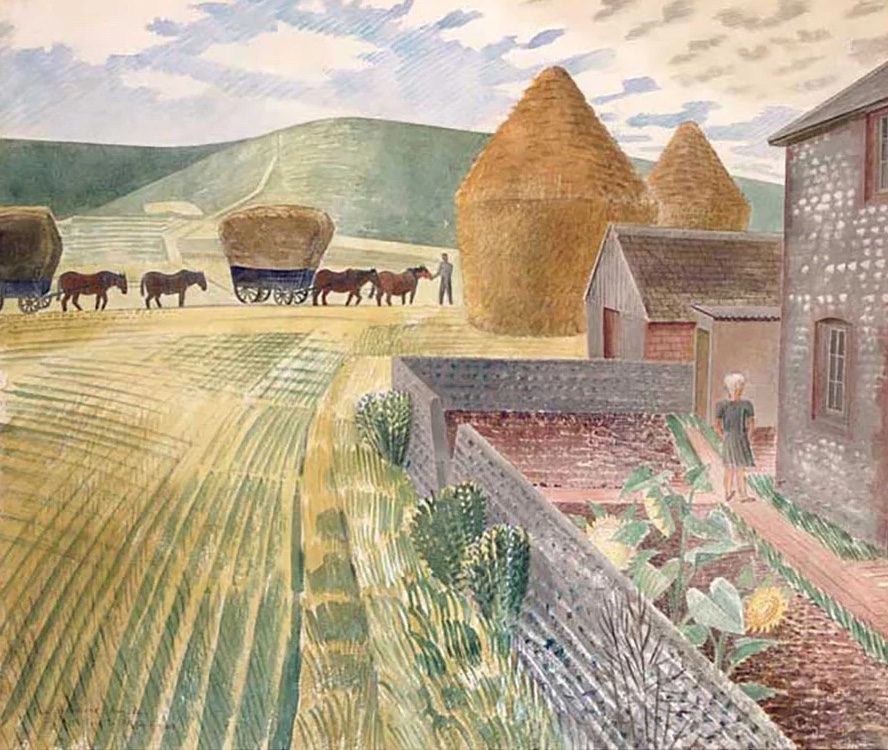
I first gave a talk on Eric Ravilious this spring for the Friends of Rye Harbour Nature Reserve, and then for Sussex Wildlife Trust. I focused on the work that Ravilious made around Rye and Sussex in the years between the two world wars.
Those years saw artists and writers slough off the heavy mantle of Victorian England and pause for a period of reflection. Many looked at their own country with new eyes. Sussex, more than anywhere, became a place of escape and experiment in different ways of making art and of living. The story of the Bloomsbury Group centred on Charleston Farmhouse and nearby Monk’s House at Rodmell is very familiar these days.
The creative gatherings that took place in the 1930s at Furlongs Farmhouse, further west at the foot of the South Downs, are rather less well known. Eric Ravilious stayed there many times and claimed that Furlongs had changed the way he saw things and painted them. It was the home of artist Peggy Angus and despite its spartan facilities was visited by some of the leading modernist artists, designers and architects of the day.
Today we increasingly acknowledge the ways in which place can influence our lives and our creativity. If we live in the moment, we become more intensely aware of what immediately surrounds us. Contemporary lives are often lived with constant distraction and mediated for us.
Ravilious brings a freshness to what he observes, sometimes joyous, sometimes unsettling. His eye is that of a designer, seeing line and shape and pattern, and much of his work was in wood engraving and other design disciplines from murals to ceramics to book illustration. Nowadays his work is recognised and reproduced widely as prints, calendars and cards. It may be familiar but it’s still fresh.